Introduction
BDPotentiometer is a python module for easy control of multichannel digital potentiometer or rheostat. The module can also be used to model analog or digital potentiometer devices using Potentiometer and DigitalWiper classes correspondingly.
Potentiometer
Potentiometer is a simple electrical component with three terminals. The two terminals A and B are connected to opposite sides of the resistor, and the third terminal W is connected to sliding contact (the wiper). This design turns potentiometer into variable voltage divider, which consist of two resistors A-W nd W-B connected in series. If a reference input voltage is applied across A-B terminals, one may control the output voltage at wiper terminal by changing its position.
Following symbols are used to depict a potentiometer. IEC standard symbol is on the left and US ANSI symbol is on the right.
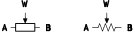
Fig. 1. Potentiometer symbols.
For the remainder of the documentation, we will stick to the IEC symbol.
Note
In BDPotentiometer wiper position is measured from terminal B to terminal A.
If \(x\) is a wiper position measured from B (\(x=0\)) to A (\(x=1\)), then
If we applied voltage \(V_{in}\) to terminal A and put terminal B to ground, output voltage \(V_{out}\) at wiper terminal would be
Rheostat
The use of only two terminals, one of which is the wiper W, turns potentiometer into rheostat or variable resistor B-W or A-W. This is the simplest application of the potentiometer.
Digital Potentiometer
The digital potentiometer is a special type of potentiometer with electronically controlled wiper position. It usually consists of a network of resistors connected in series. The movement of the wiper is emulated by electronic switches, which connect certain resistor of the network to the output terminal of the digital potentiometer. The resolution of discrete wiper movement is determined by the value of the single resistor of the network.
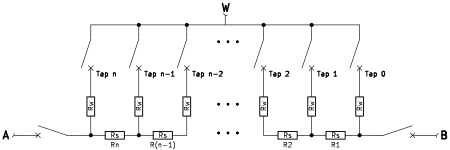
Fig. 2. Equivalent circuit of digital potentiometer with resistor ladder design.
As you can see in Fig. 2. each tap of resistor ladder has its own wiper resistance \(R_w\) (usually some tens of Ohms). Small variations of \(R_w\) are possible between taps, which can lead to a non-linear change in resistance when changing the value of the slider position. The lower the total resistance of the potentiometer, the more noticeable this effect.
If \(x\) is again a wiper position (integer this time) measured from B (\(x=0\)) to A (\(x=n\)), then
Programming Digital Potentiometer
Digital potentiometer can be controlled using its dedicated input/output pins. This could be:
Up/Down input pins for incrementing/decrementing pot’s value;
SPI interface;
I2C interface.
Some digital potentiometers have non-volatile memory for wiper position storage. Such pots restore wiper position after power cycle. Other potentiometers reset wiper position on power cycle to default value (middle tap usually).